Teaching Statement
“Making is a way of getting to know yourself."
For as long as I can remember, making things has been my way of understanding the world—and myself. When I was a kid, I wasn't great at expressing myself through words. But the moment I started drawing, cutting, or gluing, everything around me felt quieter. I felt more comfortable. Later on, when I began studying sculpture—especially working with wood—I realized that materials can "listen" to you too. Every time you saw, carve, or sand, you're not just shaping the wood—you're also telling a story. That's when I began to understand that art-making is more than just creating objects. It's a way of thinking, feeling, and discovering. And that's what brought me to teaching.
To me, art education isn't about turning students into artists. It's about helping them realize they have the right to choose, to express, and to explore. I've seen students say, "I'm not good at drawing," or "I don't know how to start." But once they find something they care about—a memory, a place, a word, or a piece of their own culture—they begin to open up. I don't give them the "right answer." Instead, I offer themes, materials, and techniques, and I invite them to find their own way in.
I design lessons that give students that opening. In one project, my 2nd- and 3rd-graders each chose a Chinese character that mattered to them and filled its outline with drawings of the memories behind it—turning a single word into a personal story, and language itself into art. My 8th-graders studied how dragons are imagined across cultures, invented original dragons with their own histories and powers, then merged their ideas into one collaborative sculpture for our school's Heritage Month celebration. With my high school students, I used maps, layered line, and text to help them build abstract self-portraits about movement, place, and identity. Across pre-K through twelfth grade, the projects change, but the invitation stays the same: this is yours to explore.
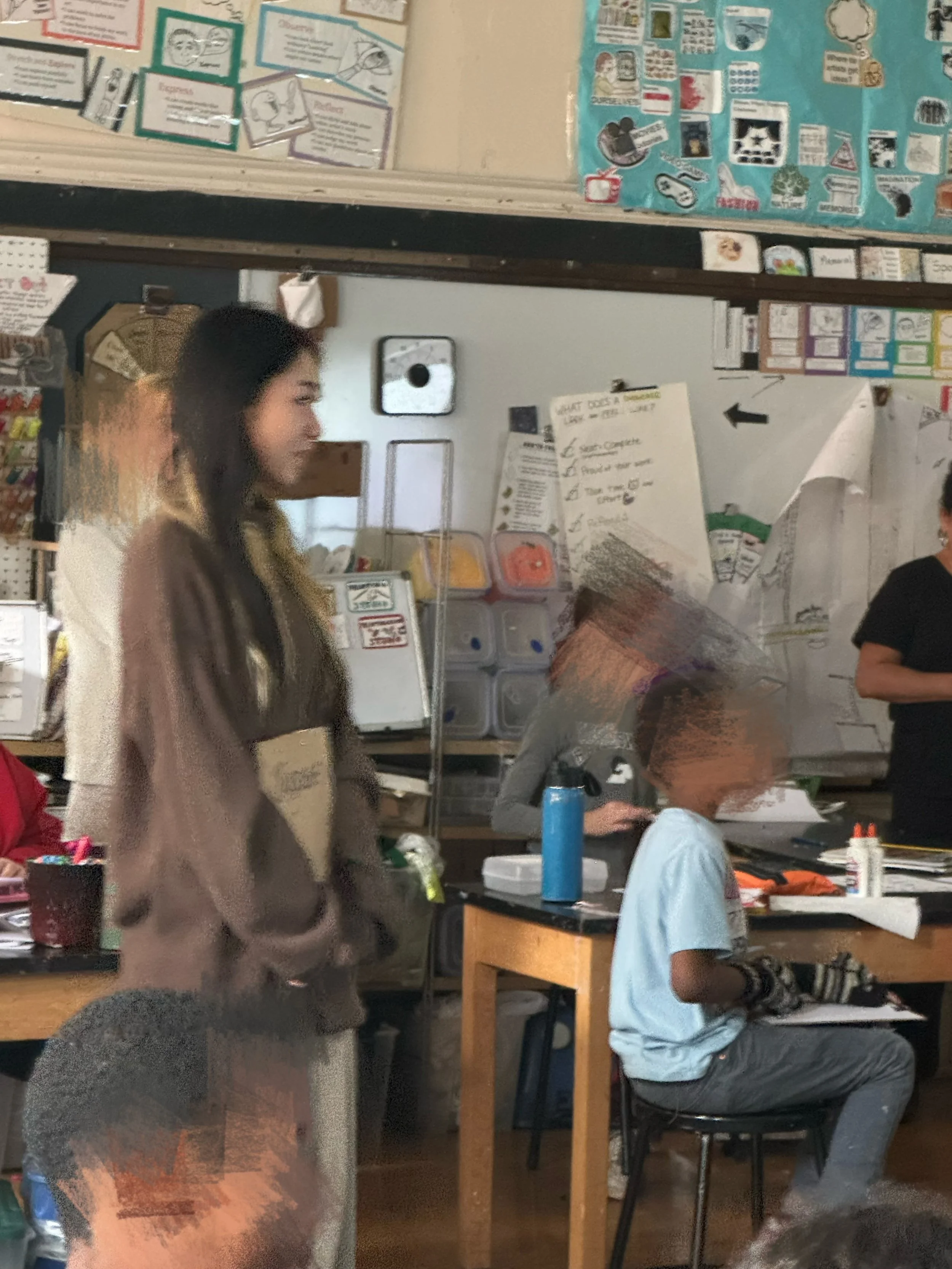
Teaching such a wide range of ages has taught me to meet students where they are—adjusting my language, materials, and pacing—while keeping that invitation open to everyone. I've also learned how much students open up when their own cultures and experiences have a place in the room, and I plan with that in mind.
My path into teaching started well before my own classroom. For three summers, I worked as a teaching assistant across SAIC summer camps—in sculpture, fashion, painting, and multi-art—supporting students from young children through high school. I later designed and taught my own after-school art classes for younger students at a private learning center. And through years as an assistant in the woodshop, I learned the balance between technical support and creative freedom: showing students how to use tools safely, helping troubleshoot their projects, and watching them grow from hesitant beginners into confident makers. Sometimes all it took was teaching someone how to saw a clean edge, and suddenly they felt ready to build something they'd been imagining. That shift—from "I can't" to "I can try"—is one of the most important things I've seen happen in a studio.
The phrase I probably say most often in class is: "Do you want to give it a try?" Because that's where everything starts. You don't need to know exactly what you're doing. You just need a moment of curiosity and a space where it's okay to explore. That's the kind of classroom I try to build—one where students feel seen, heard, and encouraged to keep asking, making, and discovering who they are through the things they create.